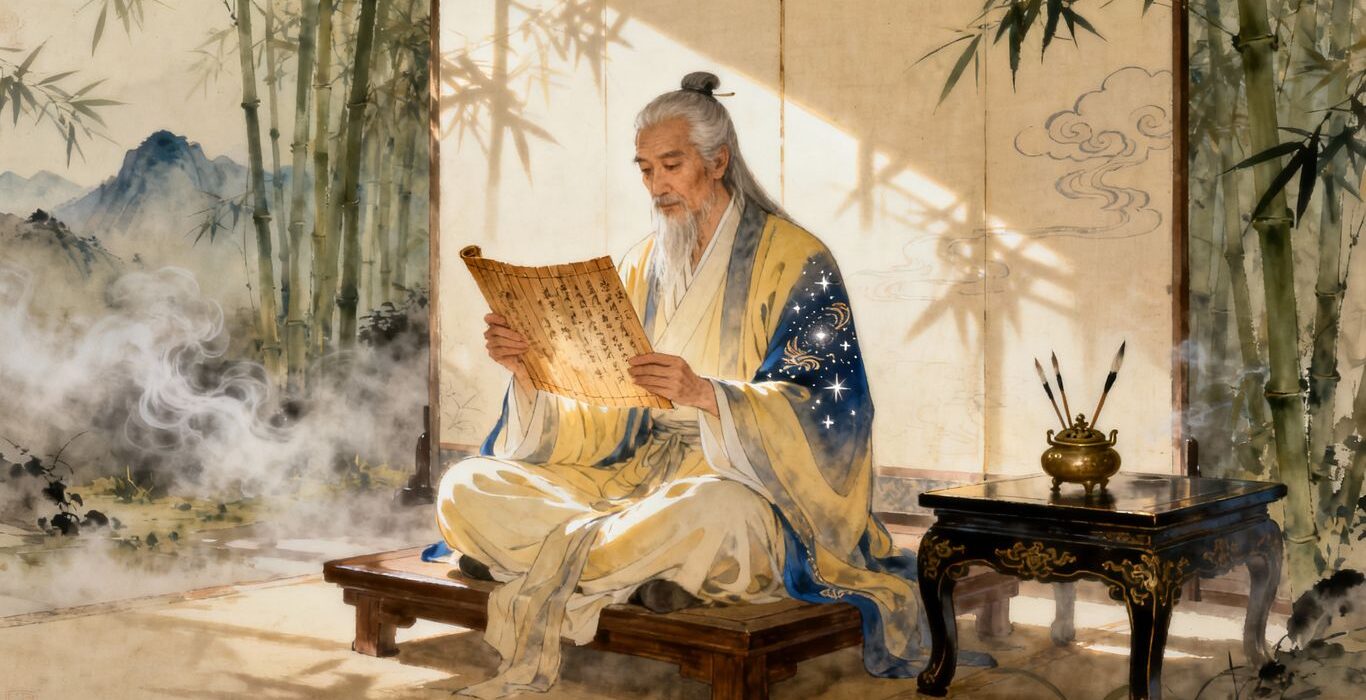
The collapse of the Han dynasty in the early third century C.E. was not merely a political event; it was an intellectual earthquake. The grand synthesis of Confucianism, cosmology, and statecraft that had provided a stable, ordered worldview for over four centuries lay in ruins. Into this vacuum of certainty stepped a new philosophical movement, one that looked back to the wisdom of pre-Qin Daoism to forge a new path. This movement, known as Xuanxue (玄學) , or the “Learning of the Mysterious,” would come to define the intellectual landscape of early medieval China, reshaping metaphysics, culture, and the very understanding of what it meant to be a sage .
The Meaning of “Mysterious”
The name Xuanxue itself points to the core of its philosophy. The word xuan (玄) is rich with meaning. Literally denoting a shade of “dark red” or “black,” it came to evoke a sense of the profound, the hidden, and the unfathomably deep . Its philosophical significance is rooted in the first chapter of the Daodejing, which speaks of the Dao as the “doorway to all mystery” (xuan). For thinkers of the Wei (220-265) and Jin (265-420) dynasties, xuan was the perfect descriptor for the Dao itself—the ultimate reality that is both the source of all things and yet forever beyond full comprehension or linguistic capture . Xuanxue, therefore, was the systematic attempt to explore and articulate the nature of this mysterious Dao and its relationship to the tangible world of being .
It is crucial, however, to understand Xuanxue not as a simple revival of pre-Han Daoism, but as something new. While the label “Neo-Daoism” is convenient, contemporary scholars like Alan Chan caution that it can be misleading, as it implies a partisan “Daoist” school . In reality, Xuanxue was a synthetic movement. Its proponents were deeply educated in the Confucian classics, and their project was not to discard the Confucian teachings on social order (mingjiao) but to ground them in a deeper metaphysical foundation derived from texts like the Laozi, Zhuangzi, and Yijing (which were collectively called the “Three Treatises on the Profound”) . They sought to reconcile the spontaneous, natural way of the Dao (ziran) with the need for a structured, moral society.
The Pillars of Early Medieval Metaphysics
The philosophy of Xuanxue was forged in the famed “Pure Conversation” (qingtan) salons of the third century, where intellectuals gathered to debate profound topics, often as an escape from the dangerous and volatile politics of the day . Two towering figures emerged from these debates, whose commentaries would become essential reading for the next millennium: Wang Bi (226-249) and Guo Xiang (d. 312).
Wang Bi, a brilliant young prodigy, wrote seminal commentaries on the Daodejing and the Yijing. His metaphysics centered on the concept of non-being, or wu (無). For Wang, wu was not mere nothingness. It was the substance or ground from which all particular things, or “being” (you), emerge. The Dao, as the “mother of all things,” is ultimately nameless, formless, and characterized by this radical absence of specific attributes . By establishing a transcendent foundation in wu, Wang Bi provided a metaphysical anchor for both the cosmos and society. The sage, in this view, embodies wu by acting without deliberate effort (wuwei), remaining empty and responsive, thereby allowing the myriad things in the world to follow their own natural course .
A century later, Guo Xiang offered a radically different interpretation in his masterful commentary on the Zhuangzi. Guo Xiang rejected Wang Bi’s notion of a transcendent, generative non-being. He argued that things are not produced by some external, primal source. Instead, they generate themselves spontaneously through a process he called “lone transformation” (duhua) . For Guo, the Dao is not a thing or a creator, but rather the self-so-ness (ziran) of all things as they are. He was a materialist and an immanentist, insisting that reality is nothing more than the constant, spontaneous interaction and transformation of individual entities. While this might seem to lead to chaos, Guo Xiang ingeniously argued that when each thing fully follows its own nature, it naturally and harmoniously fits with all others, creating a perfect, self-ordering cosmos. This philosophy justified a life of following one’s innate capacities, whether that meant ruling an empire or simply enjoying a quiet life .
A Legacy Cast in Shadow and Light
The influence of Xuanxue extended far beyond the salons of the elite. Its sophisticated metaphysical framework played a pivotal role in the Chinese reception of Buddhism. As Buddhism began to filter into China, its concepts of emptiness (śūnyatā) and the nature of reality were initially understood through the lens of Xuanxue categories, a period often referred to as “Dark Learning” or “Mystery Learning” . The intricate debates about being and non-being provided a native vocabulary that allowed Chinese thinkers to grapple with and ultimately translate the profound ideas of Indian Buddhist philosophy. In this way, Xuanxue served as a crucial bridge, preparing the ground for the flourishing of uniquely Chinese schools of Buddhist thought .
Despite its profound influence, Xuanxue was not without its critics. Its association with abstruse metaphysical debates led detractors to dismiss it as “empty talk” (kongtan), a frivolous escape from pressing social and political responsibilities . The word xuan itself took on a pejorative meaning for some, signifying obscurity for its own sake. Yet, this criticism overlooks the genuine intellectual vitality of the age. The period following the Han was not one of decline, but of intense and creative ferment .
Xuanxue represents a golden age of Chinese metaphysics. By plumbing the depths of the “dark” and “mysterious,” thinkers like Wang Bi and Guo Xiang did not turn away from the world. They sought to understand its deepest roots, providing a new language to discuss reality, human nature, and the ideal of sageliness within. In doing so, they rescued Chinese philosophy from the ruins of an empire and set it on a new trajectory that would influence everything from poetry and art to politics and religion for centuries to come.