Taiping Dao | 太平道
The Huanglao Dao tradition was the forerunner to the most important Daoist movement during the Han dynasty that inevitably toppled the government whilst suggest a sustainable and equitable social model for the masses.
Taiping Dao | 太平道
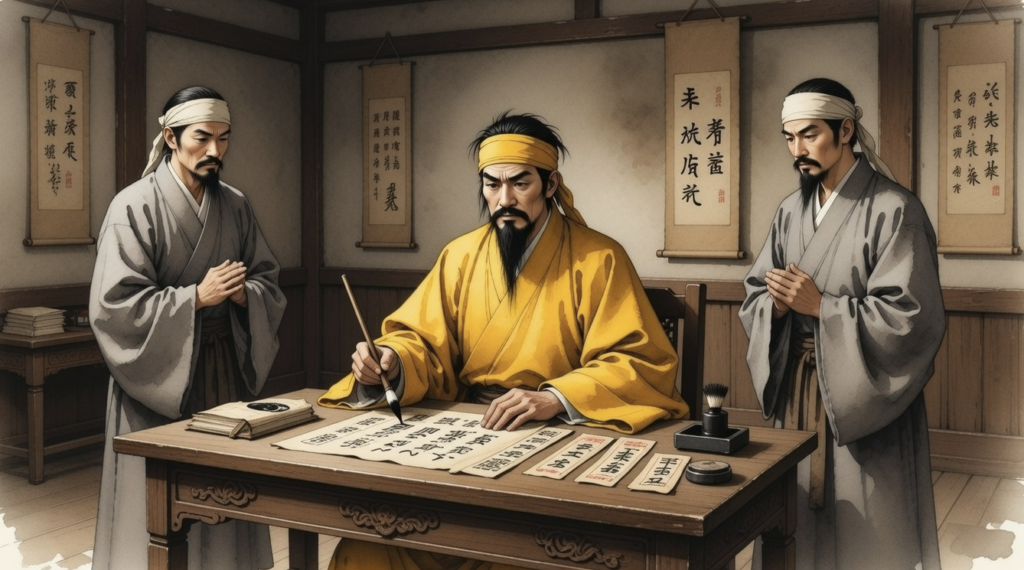
The Taipingdao 太平道 “Way of the Great Peace” is one of the oldest schools of religious Daoism. Its origins lie in popular religious movements during the Later Han period 後漢 (25-220). Only during the 160s and 170s, the figure of a leader appeared in the person of Zhang Jiao 張角. Zhang became the head of the Yellow Turban movement (Huangjin qiyi 黄巾起義), a peasant rebellion in Eastern China that tried to overthrow the Han dynasty, or at least to change the unbearable social and economical conditions of the peasantry. Zhang Jiao propagated Daoist belief in ghosts and deities, wrote talismans and incantations and healed the sick. The word Taiping for his movement first appears in Zhang Lu\’s 張魯 biography in the Sanguozhi 三國志. The term taiping is derived from the name of a Daoist writing from that period, the Taipingjing 太平經, but was also used for the rebellious movement of his adherents. The combination of religion and social change was an integral point of his teachings, just like in the movement of the Way of Five-pecks-of-grain 五斗米道 that emerged around the same time in Sichuan.
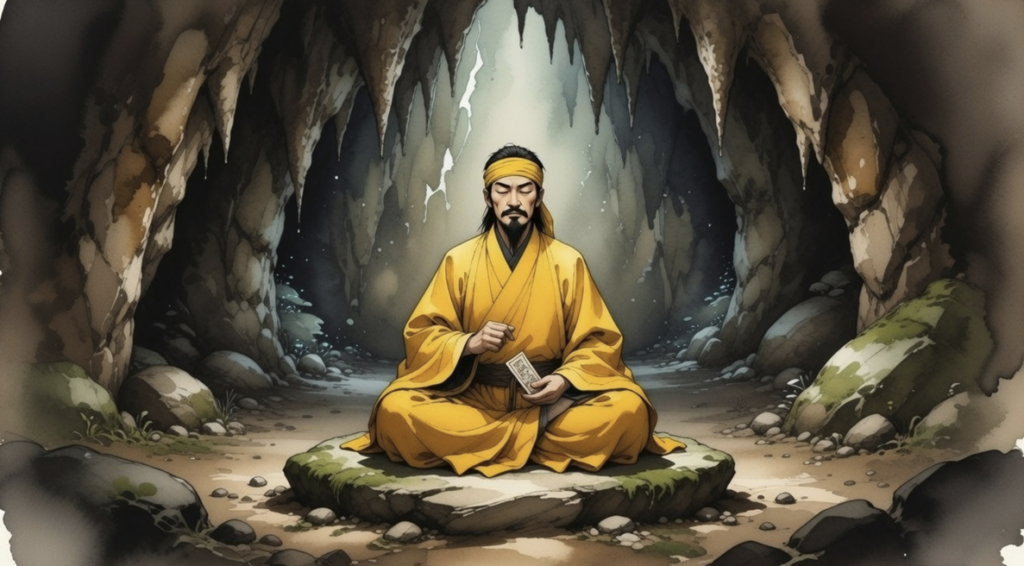
The adherents of Zhang Jiao\’s religious school believed in the effect of Yin and Yang and the Five Processes onto life, and the use of talismans and incantations to repel bad spirits and diseases. Sick persons were thought to be possessed of ghosts because of former misdoings. Repentance (si guo 思過) was an important means of relief. Talismans were written, burned and given as a potion to drink (fushui 符水 “talisman water”). The sinner had to express his repentance in the shape of kowtow before Heaven and Earth in a lucid place that opened to all four directions. All spirits would then appreciate his humiliation and ask Heaven to forgive the sinner. The talisman was written in red ink, with characters only known to the Celestial spirits. Inside the body, after being consumed, it was said to help the sick to become conscious of his sins.
In the political sphere, the peasant armies of the Yellow Turbans revered the colour yellow as that of the future dynasty. Their highest deity was the Zhonghuang taiyi 中黄太乙 “Greatest one of the central yellow”. The Yellow Turbans expected a coming ruler that would represent the spiritual force of the central and most important and auspicious element of the yellow earth. Zhang Jiao, as the great, wise and good teacher (da xianliang shi 大賢良師), propagated that the epoch of Blue Heaven (cangtian 蒼天) was over and would be replaced by that of Yellow Heaven (huangtian 黄天) in the year with the cyclical signs jiazi 甲子 (being the first year in the the 60-years cycle), namely 184 CE. The element fire, represented by the Han dynasty, was to be replaced by the element earth.
Historians call the movement Yellow Turbans Peasant Rebellion (Huangjing Minbian) because its peasant members identified themselves by wearing yellow turbans around their heads. It was the first major peasant revolt in Chinese history.The leader of Yellow Turbans Peasant Rebellion (Huangjin Minbian) was Zhang Jiao, chief patriarch of the Daoist sect of the Way of Celestial Peace (Taiping Dao).
Zhang Jiao had been an unsuccessful candidate in keju (public examinations) for officialdom. While gathering herbal medicine in the mountainous wilderness, he allegedly met an old sage named South China Ancient Sage (Nanhua Laoxian) from whom he received the 3-volume Celestial Peace Methods (Taiping Yaoshe). A talented propagandist and messianic faith-healer, Zhang Jiao proclaimed himself pope of a new religion based on a synthesis of Huangdi (Yellow Emperor), primeval mythical sovereign, and a deified Laozi.
Huangdi is the ritual appellation adopted by the first monarch in Chinese history, a man named Gongsun, allegedly born on the celestial star Xuanyuan. Legend has it that Huangdi established the first kingdom in history at Youxiong, around Zhengzhou, modern-day Henan province. During his reign, language, costume, architecture, money, measure, medicine and music were professedly invented. All Chinese consider themselves descendants of Huangdi. Huang (yellow) is the color of ripe wheat. The concept of yellow commands a mythical meaning in Chinese culture, signifying regality, prosperity and civilization, all symbolized by the color of golden harvest.
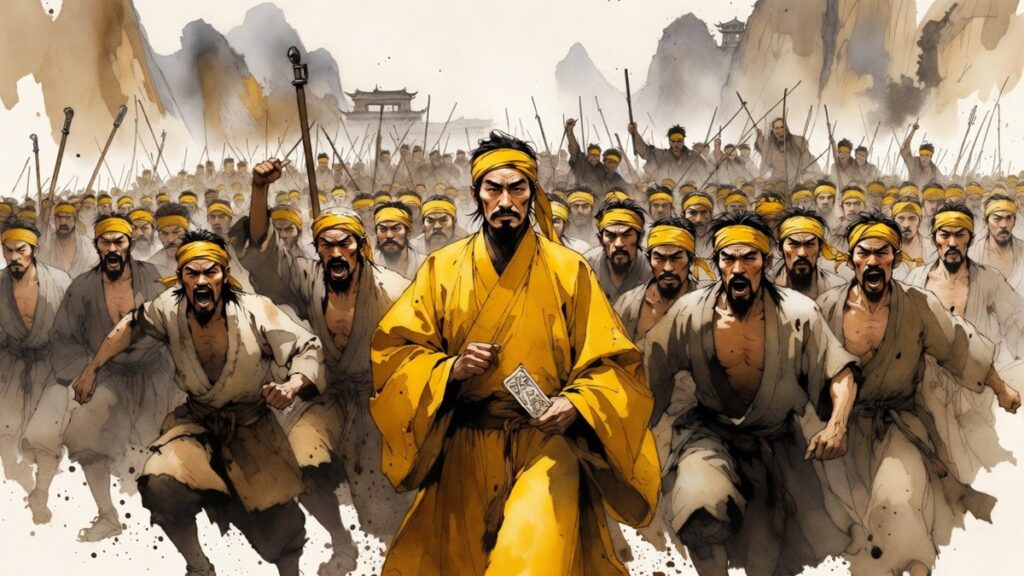
The armies of the Yellow Turbans were able to occupy the whole of northern China and the Yangtse River plain within a short time. The rebel army was divided into divisions (dafang 大方) and brigades (xiaofang 小方). His divisions were commanded by trustful generals, like Ma Yuanyi 馬元義 who conquered the Yangtse Basin and marched towards the capital Luoyang. Ma could by captured by the Han government through treason by a subordinated called Tang Zhou 唐周. Zhang Jiao himself was the Celestial General (Tiangong jiangjun 天公將軍), his brother Zhang Bao 張寳 was the Terrestrial General (Digong jiangjun 地公將軍), and Zhang Liang 張梁 the Human General (Rengong jiangjun 人公將軍). The rebels burnt down the official buildings of the government and thus attracted a huge following by their fighting against the suppressive government. After ten months of heavy fighting, the armies of the Han dynasty were able to crush the main forces of the Yellow Turbans. TYet it was not until 188 that their last stronghold could be taken. It seems that some of the followers had fled to Sichuan to join Zhang Lu\’s state of the Five-Pecks-of-Grain. he Yellow Turbans Rebellion was finally suppressed by renegade army commanders of the falling Han dynasty who became independent warlords that kept China fragmented for three more centuries, since 220, before Yang Jian reunited the country by founding the Sui dynasty in 581.
In spite of the failure of the uprising, some basic features of Zhang Jiao\’s religion influenced Daoist practice, chinese medicine and culture. Like the number 36 of the military division, the nine-section staves (jiujiezhang 九節杖) the priests had used, the yellow robes and caps, the drinking of talisman water and the use of incantations to get rid of diseases. During the Tang 唐 (618-907) and the Song 宋 (960-1279) periods, some “enlightened” Daoist schools (mingjiao 明教) revered Zhang Jiao as an ancient teacher. During the White Lotus rebellion 白蓮教 at the end of the 18th century, the leaders proclaimed the end of the Yellow Epoch in favour of the Blue Epoch, which is quite the reverse of the Yellow Turban movement, but was clearly influenced by it.
Yu Tradition | 于君道
The Master Yu Tradition (于君道 Yú Jūn Dào) is widely regarded by historians and religious scholars as a prominent southern branch of the Taiping Dao (太平道 Tàipíng Dào), the great Daoist movement that famously fueled the Yellow Turban Rebellion in northern China during the late Eastern Han dynasty. Its foundational roots lie in the legendary figure Yu Ji (于吉 Yú Jí), a Daoist master from Langya commandery (琅琊郡, in present-day Shandong), who was credited as either the author or the divine transmitter of the seminal Taiping Jing (《太平经》 Tàipíng Jīng), or the Book of Supreme Peace. This scripture was later presented to the Han court by his disciple Gong Chong (宫崇 Gōng Chóng) and served as the core theological and philosophical backbone for both the northern Taiping Dao (太平道) under Zhang Jiao (张角 Zhāng Jiǎo) and its southern offshoot. By sharing this common canonical foundation, the Master Yu Tradition (于君道) effectively operated as the southern heir to the same millenarian vision of cosmic harmony and divine intervention that defined the original Taiping movement.
In terms of doctrine and ritual practice, the Master Yu Tradition (于君道) closely mirrored the methods of its parent sect, adapting them to the different social and political environment of the Jiangnan (江南 Jiāngnán) region south of the Yangtze River. Adherents established quiet retreats known as Jingshe (精舍 Jīngshè), where they would burn incense, chant Daoist scriptures, and conduct communal worship. The most iconic and socially visible practice inherited from the Taiping Dao (太平道) was the creation of talismanic water (符水 fúshuǐ), water infused with the power of written talismans, which was administered to the sick as a form of spiritual healing. This practice was not merely a medical intervention but a tangible demonstration of the sect’s claim to restore balance and harmony to the human body, reflecting the broader Taiping cosmological principle that disorder and illness were interconnected manifestations of cosmic imbalance. Through these healing rituals, the Master Yu Tradition (于君道) gained immense popularity among the common people of Wu and Kuaiji commanderies (吴郡和会稽郡 Wú Jùn hé Kuàijī Jùn), establishing a strong grassroots presence that distinguished it from the elite Confucian traditions of the time.
The geographical transmission and organizational development of the Master Yu Tradition (于君道) were direct results of the chaotic political upheavals that marked the end of the Han dynasty. As civil wars and famine ravaged the northern plains, large populations, including Daoist practitioners from both the Taiping Dao (太平道) and the rival Way of the Celestial Masters (五斗米道 Wǔdǒumǐ Dào), migrated southward in search of refuge. This mass migration carried the religious technologies and scriptures of the Taiping Dao (太平道) into the Yangtze River delta, where the Master Yu Tradition (于君道) took root. Interestingly, the historical figure active in the south during the Three Kingdoms period was likely not the original Yu Ji (于吉) from the north, but rather a later successor who assumed the founding master’s name to legitimize his authority. This practice of pseudepigraphy indicates that the Master Yu Tradition (于君道) functioned as an organized transmission lineage that used the founder’s charisma as a symbolic anchor, allowing it to coexist and compete with other southern groups, such as the Bojia Dao (帛家道 Bójiā Dào) and the later Li Tradition (李家道 Lǐjiā Dào), both of which also traced their origins to northern Daoist movements.
The flourishing of the Master Yu Tradition (于君道) in the south, however, proved to be tragically short-lived, primarily because its growing influence brought it into direct and fatal conflict with the rising secular power of the region. The warlord Sun Ce (孙策 Sūn Cè), who was consolidating his control over the Jiangdong (江东 Jiāngdōng) territories to establish the future state of Eastern Wu (东吴 Dōng Wú), viewed the sect’s immense popularity with deep suspicion. He accused Yu Ji (于吉) of “deluding the hearts of the people” (幻惑众心 huànhuò zhòngxīn), a charge that framed the sect’s religious authority as a direct political challenge to his own governance. Despite desperate pleas from his mother and senior officers, Sun Ce (孙策) had Yu Ji arrested and executed around the year 200 AD.
Following the execution of its leader, the institutional structure of the Master Yu Tradition (于君道) rapidly collapsed under state pressure. However, its spiritual legacy did not entirely vanish. Among its devout followers, the death of Yu Ji (于吉) was not accepted as a true end; instead, they reinterpreted his demise through the Daoist lens of Shijie (尸解 Shījiě), or “Deliverance from the Corpse,” a concept wherein an adept sheds their physical body as a mere shell to ascend as an immortal. Consequently, followers continued to offer sacrifices and pray to him privately for blessings. Nevertheless, the formal organization of the sect faded from historical records. Its specific practices, textual traditions, and remaining congregants were eventually absorbed by the rising Li Tradition (李家道 Lǐjiā Dào) in the same southern region, which filled the religious vacuum left by its decline. In conclusion, while the Master Yu Tradition (于君道) had only a brief historical existence, it stands as a crucial transitional chapter in the history of Daoism, demonstrating how the classical Taiping Dao (太平道) adapted to new southern environments and illustrating the ongoing dialectic between messianic religious communities and the unforgiving demands of political state-building during the turbulent transition from Han to the Three Kingdoms.
The Master Yu Tradition flourished during the Three Kingdoms period (AD 220-280). It was a short-lived sect which spread from North to South, primarily within the confines of East Wu, a state in the middle and lower reaches of the Yangtze river. The sect took as its founder Yu Ji, a famous Daoist of the Eastern Han dynasty (AD 25-220) who had preached Taiping Qingling Shu (The Book of Supreme Peace). This connection has led scholars to believe the Master Yu Tradition was either related to or a branch of the Supreme Peace Sect (太平道 Taiping Dao)
During the Three Kingdoms era when the Master Yu Tradition saw its spread in East Wu, a Daoist going by the name of Yu Ji came to Wuhui and set up temples where he burned incense, read Daoist scriptures and made Talismanic Water to cure the sick. Owing to his healings, many people in Wuhui became his followers. However, in order to prevent him from “Misleading the people”, Shun Ce, king of East Wu, had him killed. This Daoist had obviously been preaching to the public using the name of the previous Yu Ji, who had lived during the Eastern Han dynasty. After his death, his followers denied that he could be killed. Instead, they regarded his apparent death as a case of “Deliverance from the Corpse”. They continued to worship him for a long time. After the decline of the Master Yu Tradition, the Li Tradition started to prosper in the southern reaches of the Yangtze river.
Li Tradition | 李家道
The decline of the Master Yu Tradition (于君道 Yú Jūn Dào) after the execution of its leader by the warlord Sun Ce (孙策 Sūn Cè) did not mark the end of the Taiping Dao (太平道 Tàipíng Dào) lineage in the South. Instead, it created a religious vacuum that was quickly filled by another significant movement: the Li Tradition (李家道 Lǐjiā Dào). The Li Tradition (李家道) thus emerged not merely as a contemporary, but as the spiritual successor that would carry forward the legacy of popular, healing-focused Daoism in the Jiangnan (江南 Jiāngnán) region during the Wei and Jin dynasties (魏晋 AD 220-420),
The Li Tradition (李家道) had a distinct geographical and mythological origin. It originated in the Shuzhong (蜀中 ) region of Sichuan and was centered on the veneration of a legendary figure known as Li Babai (李八百 Lǐ Bābǎi), an immortal said to be eight hundred years old. The tradition was transmitted to the Wu region by two key figures: Li A (李阿 Lǐ Ā) and Li Kuan (李宽 Lǐ Kuān). Interestingly, Li Kuan, who spoke with a Sichuan dialect upon arriving in Wu, was so effective in his healing that the local populace came to believe he was the immortal Li Babai himself, further cementing the tradition’s identity and appeal.
Despite their different origins, the Li Tradition (李家道) closely mirrored the practices of its predecessor. Like the Yu Tradition (于君道) and the Taiping Dao (太平道) before it, the core of the Li Tradition’s (李家道) religious practice was healing the sick through the use of符水 (fúshuǐ), or talismanic water, and祝水 (zhùshuǐ), a form of prayer over water. The tradition established修道斋戒之室 (cultivation and fasting chambers) known as Lu (庐 Lú), which served a similar communal function to the Jingshe (精舍 Jīngshè) retreats of the Yu Tradition (于君道).
However, the Li Tradition (李家道) proved to be more resilient and successful than its predecessor. It avoided the fatal conflict with secular authorities that had destroyed the Yu Tradition (于君道) and managed to spread its influence widely, gaining followers not only among the common people but also among the social elite, with “自公卿以下” (from dukes and ministers on down) flocking to its doors. The rise of the Li Tradition (李家道) in the wake of the Yu Tradition (于君道) represents a key transition in the history of early Daoism. It illustrates how the popular, millenarian religious current from the north, as exemplified by the Taiping Dao (太平道), was transplanted to the south.
Bo Tradition | 帛家道
The Bo Tradition (帛家道 Bójiā Dào), also known as the “Way of the Bo lineage,” was another significant early Daoist school that, like the Yu Tradition (于君道 Yú Jūn Dào), was active during the Wei and Jin periods (魏晋时期, AD 220-420) in both the northern heartlands and the Jiangnan (江南 Jiāngnán) region of Jiangsu and Zhejiang. Its origins remain mysterious even today. Its origins are traced to the legendary patriarch Bo He (帛和 Bó Hé, also written Bai He 白和), a figure from the late 3rd century who was said to have been taught by the famous master Dong Feng (董奉 Dǒng Fèng) and later achieved immortality as an “earth immortal” (地仙 dìxiān). The school’s foundational scriptures were the very texts Bo He claimed to have discovered after staring at a wall in a mountain cave for three years: the Great Heavenly Writs of the Three August Ones (三皇天文大字 Sānhuáng Tiānwén Dàzì), the Perfect Map of the Five Sacred Mountains (五嶽真形圖 Wǔyuè Zhēnxíng Tú), and the Prescriptions for Divine Elixirs (神丹方 Shéndān Fāng). The Bo Tradition (帛家道) is linked to the same lineage we have been tracing, as some accounts state that Bo He (帛和) transmitted the Taiping Jing (《太平经》 Tàipíng Jīng) to Yu Ji (于吉 Yú Jí). This connection, along with the school’s emphasis on talismanic texts and healing, suggests it was part of the same broader network of early, popular Daoist movements that emerged from the remnants of the Yellow Turban rebellion.
Its methods included alchemy, breath circulation (行气 xíngqì), and techniques of summoning and suppressing spirits (召劾厌胜 zhàohé yànshèng). Ge Hong (葛洪 Gě Hóng), our primary source for these traditions, documented the Bo Tradition (帛家道) in his Baopuzi (《抱朴子》 Bàopǔzǐ), and some scholars, like Chen Guofu (陈国符 Chén Guófú), have even speculated that Ge Hong and his master, Zheng Yin (郑隐 Zhèng Yǐn), may have belonged to this very school. Initially spreading among the lower classes, the tradition gained traction among the aristocracy during the Eastern Jin (东晋, AD 317-420), with prominent southern families like the Xu (徐), Hua (华), Xu (许), and Ge (葛) clans adopting its practices. Ultimately, like the Yu (于君道) and Li (李家道) Traditions before it, the Bo Tradition (帛家道) did not survive as an independent entity. It gradually faded and was absorbed into the more established and organized Celestial Masters Tradition (天师道 Tiānshī Dào) and the emerging Highest Clarity Sect (上清派 Shàngqīng Pài) during the Southern and Northern Dynasties (南北朝 Nán-Běi Cháo). Its legacy, however, lived on through the texts it preserved and the practices it transmitted, which became foundational elements of these later, more institutionalized Daoist schools.
Ge Tradition | 葛家道
Ge Hong (葛洪, 283–343 CE) is the single most pivotal figure in the transition from the communal, folk-oriented Daoism of the Han dynasty, represented by the Taiping Dao (太平道 Tàipíng Dào), the Yu Tradition (于君道 Yú Jūn Dào), and the Li Tradition (李家道 Lǐjiā Dào), to the refined, individualistic pursuit of personal transcendence that would define elite Daoism for centuries. His life, intellectual formation, and historical circumstances all conspired to make him the architect of this profound religious transformation.
Ge Hong was born into a prominent but declining aristocratic family in Danyang commandery (丹阳郡), in present-day Jiangsu province, within the Jiangnan (江南 Jiāngnán) region that had become a refuge for northern refugees after the fall of the Western Jin dynasty (西晋 Xī Jìn). His family had deep ties to the Daoist traditions of the south. His grand-uncle, Ge Xuan (葛玄 Gě Xuán), was a famous Daoist adept who had studied under the legendary master Zuo Ci (左慈 Zuǒ Cí) and was later venerated as the founding patriarch of the Lingbao School (灵宝派 Língbǎo Pài). This family connection gave Ge Hong early exposure to the esoteric traditions of alchemy and talismanic practice. However, his most important teachers were Zheng Yin (郑隐 Zhèng Yǐn) and Bao Jing (鲍靓 Bào Jìng). Zheng Yin was a reclusive master who possessed an extensive library of Daoist texts, including the Taiping Jing (《太平经》 Tàipíng Jīng), the foundational scripture of the Taiping Dao (太平道), and esoteric works on alchemy and talismans. Crucially, scholars such as Chen Guofu (陈国符 Chén Guófú) have argued that both Zheng Yin and Ge Hong belonged to the Bo Tradition (帛家道 Bójiā Dào), as the texts Zheng Yin transmitted, including the Great Heavenly Writs of the Three August Ones (三皇天文大字 Sānhuáng Tiānwén Dàzì) and the Perfect Map of the Five Sacred Mountains (五嶽真形圖 Wǔyuè Zhēnxíng Tú). were precisely those associated with the Bo Tradition’s patriarch, Bo He (帛和 Bó Hé). Through Zheng Yin, Ge Hong inherited not only the Bo Tradition’s textual corpus but also the broader lineage of the Taiping Dao (太平道), since the Taiping Jing (《太平经》) was central to both traditions. This placed Ge Hong squarely within the intellectual and spiritual lineage that stretched from the Yellow Turban rebellion through the southern folk traditions of the Yu (于君道) and Bo (帛家道) schools.
The turbulent era in which Ge Hong lived profoundly shaped his rejection of the communal, activist model of the earlier Daoist traditions. He was born just after the devastating upheavals of the late Western Jin dynasty (西晋), including the Rebellion of the Eight Princes (八王之乱 Bā Wáng Zhī Luàn) and the subsequent invasion by northern nomadic tribes, which forced the Jin court to flee south and establish the Eastern Jin (东晋 Dōng Jìn) in Jiankang (建康, modern Nanjing). This period of relentless warfare, political intrigue, and social collapse left a deep mark on Ge Hong’s psyche. He witnessed firsthand the catastrophic consequences of mass movements like the Yellow Turban Rebellion, which had been fueled by the millenarian visions of Zhang Jiao (张角 Zhāng Jiǎo) and the Taiping Dao (太平道). To Ge Hong, such movements were not paths to salvation but engines of chaos and destruction. His own family had suffered from the turmoil, and he himself served as a military officer in campaigns against rebels, an experience that further disillusioned him with the idea that religious activism could bring peace to the world. Consequently, he turned away from the communal ethos of the Taiping Dao (太平道) and its southern branches, seeking instead an individual path of escape from a world he deemed irredeemably corrupt. His famous declaration in the Baopuzi (《抱朴子》 Bàopǔzǐ) that “a wise man hides himself when the times are out of joint” perfectly encapsulates this shift from worldly engagement to otherworldly withdrawal.
Drawing on the textual traditions he inherited from Zheng Yin and the Bo Tradition (帛家道), Ge Hong systematically dismantled the ritual framework of the earlier folk traditions and replaced it with a sophisticated system of personal cultivation aimed at achieving physical immortality. He rejected the practices of the Yu Tradition (于君道) and Li Tradition (李家道), burning incense, chanting scriptures, and administering talismanic water (符水 fúshuǐ) to the masses, as mere “demonic ways” (妖道 yāo dào) that could never produce genuine transcendence. Instead, he argued that the only true path to immortality lay in the ingestion of golden elixirs and cinnabar (金丹 jīndān), which required years of meticulous laboratory work, access to rare minerals, and secret textual transmissions. This shift from communal ritual to individual alchemy was not merely a matter of technique but a profound theological reorientation. The goal was no longer to bring cosmic peace to society, as the Taiping Dao (太平道) had promised, but to achieve personal liberation from mortality, ascending as a transcendent immortal (仙 xiān) to the celestial realms. Crucially, Ge Hong’s system was deeply elitist; he believed that immortality was reserved for those of exceptional moral character and aristocratic status, who possessed the wealth to fund alchemical experiments and the education to understand esoteric texts. This effectively transformed Daoism from a mass movement of the disenfranchised into a refined pursuit of the privileged elite, ensuring its survival within the aristocratic culture of the Southern Dynasties.
Beyond his religious innovations, Ge Hong made monumental contributions to the practical arts of health, medicine, and spiritual cultivation. In medicine, his Handbook of Prescriptions for Emergencies (《肘后备急方》 Zhǒuhòu Bèijí Fāng) is a pioneering work of clinical medicine that contains some of the earliest documented treatments for infectious diseases. Remarkably, it includes the first known description of the use of Artemisia annua (qinghao 青蒿) to treat malaria, a discovery that would not be rediscovered in the West until the 20th century and which earned the Nobel Prize for the Chinese scientist Tu Youyou (屠呦呦 Tú Yōuyōu) in 2015. He also compiled treatments for wounds, insect bites, and epidemics, drawing on folk knowledge while filtering it through his own empirical observations. In alchemy, the Baopuzi (《抱朴子》) contains detailed recipes for the preparation of elixirs, including the exact proportions of minerals, the construction of alchemical furnaces, and the precise heating times required for successful transmutation. These recipes represent some of the earliest systematic chemical procedures in human history, combining practical metallurgy with elaborate ritual symbolism. In the realm of meditation and internal cultivation, Ge Hong advocated for xingqi (行气 xíngqì), or breath circulation, and shouyi (守一 shǒuyī), or “guarding the One,” techniques that involved visualizing the deities dwelling within the human body and harmonizing the vital energies. These internal practices, which he presented as complementary to alchemical ingestion, laid the groundwork for the later developments of the Shangqing School (上清派 Shàngqīng Pài), which would elevate visualization and internal meditation to the highest levels of Daoist practice. Through these diverse contributions, Ge Hong not only preserved the fragmented traditions of the Bo (帛家道), Yu (于君道), and Taiping Dao (太平道) schools but also synthesized them into a comprehensive system that would dominate Chinese religious culture for centuries, ensuring that the legacy of these earlier traditions survived, transformed, refined, and reimagined, as the bedrock of classical Daoist practice.
Note:
Although Ge Hong did not personally found a new religious sect during his lifetime, he is venerated as a crucial precursor and key transmitter of the Lingbao School (灵宝派), also known as the Gezao School (阁皂宗 Gézào Zōng) or the “Ge Family Tradition” (葛家道 Gějiā Dào). The formal establishment of the Lingbao School is generally attributed to his grand-nephew, Ge Chaofu (葛巢甫 Gě Cháofǔ), who lived during the Eastern Jin dynasty (东晋 Dōng Jìn). Ge Chaofu compiled and edited a large corpus of scriptures known as the Lingbao Scriptures (《灵宝经》 Língbǎo Jīng)
Ge Hong is also grouped with the renowned Southern Dynasties alchemist and physician Tao Hongjing (陶弘景 Táo Hóngjǐng, 456–536 CE) to form what modern scholars refer to as the Tao-Ge School (陶葛学派), is characterized by its emphasis on empirical observation, rational methodology, and technological innovation in the fields of alchemy (both external elixir-making and internal cultivation), pharmacology, and medicine. It represents a distinctly rational and proto-scientific current within Chinese intellectual history, one that sought to actively explore and manipulate the natural world through experiments, precise measurements, and meticulous documentation. Ge Hong’s Baopuzi (《抱朴子》) contains some of the earliest detailed chemical recipes in human history, while his medical handbook, the Handbook of Prescriptions for Emergencies (《肘后备急方》 Zhǒuhòu Bèijí Fāng), pioneered treatments for infectious diseases that were centuries ahead of their time.
Ge Hong’s tradition can be understood on two distinct levels: in religious and organizational terms, he is the foundational patriarch of the Lingbao School (灵宝派), also known as the “Ge Family Tradition” (葛家道), which became one of the three main Daoist schools of the Southern Dynasties; in intellectual and practical terms, he is the co-founder of the Tao-Ge School (陶葛学派), a scientific tradition that combined religious alchemy with rational medicine and chemistry. Both traditions, however, share a common root in his personal synthesis: a transformation of the communal, healing-focused folk traditions of the Taiping Dao (太平道), Yu Tradition (于君道), Li Tradition (李家道), and Bo Tradition (帛家道) into a sophisticated, elite, and practice-oriented system that profoundly shaped both Chinese religion and science for over a millennium.
TODAY
Qigong and Meditation
In the time of Ge Hong (葛洪), breath circulation (xíngqì), along with gymnastic exercises (导引 dǎoyǐn) and dietary regulation, was considered a core method for achieving physical immortality and transcending the mortal realm. Today, however, these practices have transcended the boundaries of Daoist monasteries and become deeply embedded in the broader culture of health and wellness in China and around the world. They have evolved into what is now widely known as Qigong (气功 Qìgōng) and Neidan (内丹 *Nèidān, or Internal Alchemy). While the specific forms and lineages vary greatly, the fundamental principle remains the same: regulating the breath through inhalation and exhalation (吐纳 tǔnà) to guide and circulate the vital energy (qì) within the body, thereby strengthening the internal organs, calming the mind, and, for the dedicated practitioner, advancing along the path of spiritual cultivation. Furthermore, in the field of traditional Chinese medicine, many practitioners, known as Daoist physicians (道医 dàoyī), still employ xíngqì and dǎoyǐn as therapeutic interventions for chronic and difficult-to-treat conditions like diabetes and hypertension, demonstrating the enduring practical value of these ancient techniques.
Folk Traditions
The complex of practices known as zhàohé yànshèng encompasses the invocation and judgment of spirits (zhàohé) and the use of talismans, objects, or rituals to subdue or suppress malevolent forces (yànshèng). Talismans (符 fú), the primary function of many Daoist talismans is precisely to summon, command, and suppress spirits and demonic forces. The underlying theory is rooted in the principle of yin-yang mutual overcoming (阴阳相克 yīnyáng xiāng kè). For example, a talisman might use the character for “soul” (魄 pò) or “haunt” (嚣 xiāo) and charge it with yang energy to subdue yin entities, or use characters like “upright” (正 zhèng) or “blade” (刀 dāo) to overcome evil influences. The forms of yànshèng are diverse and have persisted in various ways: in certain folk Feng Shui (风水 Fēngshuǐ) practices still common across Asia.
Chinese Medicine
Acupuncture’s integration with the Five Elements (五行 wǔxíng) is particularly astute, as this theoretical synthesis indeed finds one of its earliest and most systematic expressions in the Taiping Qingling Shu (《太平清领书》). As one of the earliest and most important Daoist scriptures, the Taiping Jing (《太平经》) explicitly lists acupuncture (针 zhēn) and moxibustion (灸 jiǔ) among its primary methods for cultivating health and treating illness. The text states that acupuncture serves to “regulate and harmonize the three hundred and sixty pulses, unblock the qi of yin and yang, and thereby eliminate disease” (调安三百六十脉,通阴阳之气而除病). This description aligns perfectly with the foundational theory of Traditional Chinese Medicine (中医 Zhōngyī) today, which holds that acupuncture works by “unblocking the meridians and channels and harmonizing yin and yang” (疏通经络,调和阴阳).
Furthermore, the Taiping Jing (《太平经》) itself employs the framework of yin-yang and the Five Elements as its primary explanatory model for both cosmology and healing practice. Thus, the integration of the Five Elements into acupuncture theory is not a later addition but is present from the very beginning of the Daoist medical tradition. Today, acupuncture, together with the broader system of Chinese herbal medicine and qìgōng, has long since transcended its religious origins to become a globally recognized and respected system of healthcare. It is taught in universities, practiced in hospitals, and increasingly subjected to scientific research, all while maintaining its theoretical core in the ancient Daoist principles of yin-yang and the Five Elements. In this way, the legacy of the Taiping Qingling Shu (《太平清领书》) and the traditions that preserved and transmitted it,the Taiping Dao (太平道), the Yu Tradition (于君道), the Li Tradition (李家道), the Bo Tradition (帛家道), and the synthesis of Ge Hong (葛洪), continues to shape the health and spiritual lives of millions of people today.