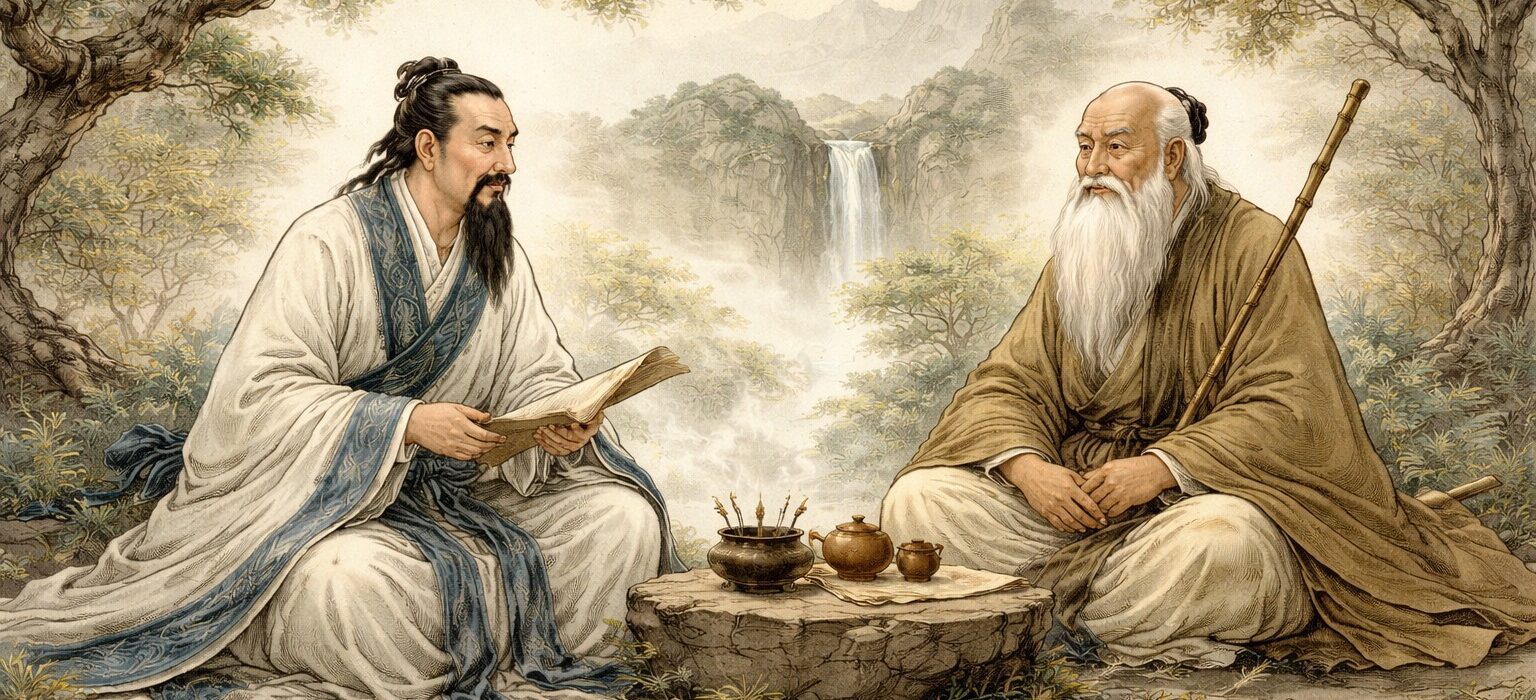
In the middle of the twelfth century, a disillusioned scholar and soldier named Wang Chongyang underwent a spiritual transformation that would reshape the landscape of Daoism. Born Wang Zhe in 1113 near present-day Xi’an, he was raised within a local elite family and trained in the Confucian classics. His early attempts at official and military careers failed, and for a period he fell into despair and alcoholism. Yet in 1161, at the age of forty-eight, he abandoned worldly ambition and embraced the life of a Daoist renunciant. A series of mystical experiences compelled him toward lifelong religious training aimed at complete psychosomatic transformation.
From this personal awakening emerged the early Quanzhen movement, known in English as Complete Perfection. What began as a small eremitic community in Shaanxi and later Shandong would grow into one of the most influential Daoist monastic traditions in Chinese history. Under the leadership of Wang and his disciples, especially Ma Yu and Qiu Chuji, Complete Perfection expanded from a regional ascetic circle into a national monastic order.
At its origin, however, the movement was intimate and experimental. Wang gathered a small group of disciples later remembered as the Seven Perfected. Formal affiliation required renunciation of what Wang called the Four Hindrances: alcohol, sexual indulgence, wealth accumulation, and anger. This was not merely moralism but energetic discipline. For Wang, spiritual realization required conserving and refining the fundamental constituents of life.
Yet the early Complete Perfection movement did not restrict itself to hermits and celibate renunciants. As Wang traveled through Shandong, he established a series of lay associations, including the Jade Flower Society in Dengzhou and the Gold Lotus Society in Ninghai. These meeting halls functioned as centers for communal ritual, ethical instruction, and introductory meditation practice. They provided a space where laypeople could encounter Complete Perfection teachings without immediately renouncing family life.
It was for one such lay community that Wang composed the “Guidance for the Jade Flower Society,” preserved in his anthology Quanzhen ji. Likely delivered as a public address near the end of his life, the text offers a rare glimpse of Wang speaking directly to householders and patrons. The tone is pastoral, practical, and surprisingly restrained.
The opening metaphor sets the doctrinal framework. The Jade Flower is called the ancestor of qi, while the Gold Lotus is the ancestor of spirit. When qi and spirit bind together, this union results in spirit immortality. Wang cites a commentary to the Yinfu jing that states, “Spirit is the child of qi; qi is the mother of spirit.” When child and mother meet, one may become a spirit immortal.
Here Wang articulates a core principle of internal alchemy. Qi is the vital force animating the body. Spirit is the luminous awareness that emerges from refined qi. If qi is scattered through indulgence and distraction, spirit becomes unstable. If qi is conserved and gathered, spirit matures and stabilizes. The language is familial rather than mechanical. Cultivation is a matter of reunion and nourishment, not forceful manipulation.
Wang then explains why he established the Jade Flower and Gold Lotus societies. The purpose was not to teach minor techniques for gaining blessings or extending lifespan. Rather, it was to help people recognize their perfect innate nature. Without insight into the true source, practitioners may become lost in subsidiary methods that promise worldly benefits but do not lead to immortality in the Daoist sense.
This emphasis introduces the classical pairing of innate nature and life-destiny, known as xing and ming. Innate nature refers to the heart-mind and spiritual capacity. Life-destiny refers to the embodied foundation of vitality, including essence and qi. A slight error in balancing these two can lead one astray from the human path. For Wang, authentic cultivation must address both consciousness and corporeality.
Yet in addressing laypeople, Wang adopts a strikingly minimalist tone. He tells them that if they truly wish to cultivate, they should simply eat when hungry and sleep when tired. There is no need, he says, to practice formal meditation or to study abstruse doctrines. Instead, they must remove themselves from mundane entanglements and allow the heart-mind to become clear and pure. Beyond these two words, clarity and purity, there is no cultivation.
This statement can be misunderstood if abstracted from its audience. Wang was not rejecting meditation as such. His own life included prolonged retreats and disciplined stillness practice. But for lay adherents immersed in family and work, he prioritized simplicity. Rather than encouraging premature asceticism, he pointed them toward foundational awareness within daily life. Eating and sleeping become acts of attunement when freed from excess craving and distraction.
The text continues by urging practitioners to cherish discernment and wisdom. In the purification chamber, meaning a secluded space for reflection, they should carefully examine themselves each day. They must avoid drifting into other teachings that promise novelty but lack depth. True accomplishment and true practice are not external achievements but inward realizations.
To clarify this distinction, Wang quotes an earlier Daoist master. If one desires perfect accomplishment, one must purify the heart-mind and stabilize intention. Spirit and emotion must be gathered and disciplined. In a state free from compulsive movement and contrived activity, genuine clarity and purity arise. One should embrace the Origin and guard the One, preserve spirit and stabilize qi. This is true accomplishment.
Here we see the quietist core of Complete Perfection practice. “Guarding the One” refers to a non-dual meditative awareness that rests in unity rather than fragmentation. It resonates with passages in the Daode jing and the Zhuangzi, texts that profoundly influenced Wang’s thought. The aim is not trance but integration. When heart-mind is stable and qi is preserved, spirit naturally clarifies.
The teaching then turns outward. If one desires perfect practice, one must cultivate humaneness and accumulate virtue. Relieve poverty, assist those in suffering, and encourage suitable people to enter the Dao. In all actions, place others before oneself and remain selfless toward the myriad beings. This is true practice.
The structure of the discourse is deliberate. Inner stabilization and outer compassion are presented as complementary dimensions. Spiritual refinement without ethical expression is incomplete. Ethical activism without inner clarity lacks foundation. For Wang, the alchemical union of qi and spirit must manifest as benevolence in the world.
The “Guidance for the Jade Flower Society” thus reveals a founder attentive to context. He does not impose monastic discipline on householders. Instead, he offers a graduated path. Begin with clarity and purity in daily conduct. Regulate food and sleep. Simplify the heart-mind. Gradually stabilize qi and spirit. Extend compassion outward. Through these integrated steps, even lay practitioners may align with the deeper currents of the Dao.
Historically, such lay associations played a crucial role in the institutionalization of Complete Perfection. They created networks of patronage and communal identity that allowed the movement to expand. Yet beyond institutional growth, the text preserves something more intimate. It records a teacher concerned that his followers not mistake peripheral techniques for essential realization.
In the final lines, Wang expresses a humble wish that all adepts may soon receive these instructions and attain clear understanding. The tone is not authoritarian but invitational. He speaks not as a distant immortal but as a guide attentive to the capacities of his audience.
For contemporary readers, the discourse offers a reminder that spiritual depth does not require theatrical extremity. It begins with clarity in the heart-mind, stability in qi, and compassion in action. In Wang Chongyang’s vision, immortality is not escape from the human condition. It is the maturation of qi and spirit within it, guided by simplicity, discernment, and virtue.