Daoist Medicine is the foundation of TCM/Modern Chinese Medicine. The Daoist concepts underpin the method of Medicine, but also of longevity practices where the way to living and prevention of illness are central. Daoist medicine maintains to the underpinning methods that help to achieve natural healing and practices aligned to health cultivation. Like the origins of Daoism, Medicine is based on the early Huang Lao Daoism (Taiping Dao) practices. These include the learnings from the earlier classics such as the Dao De Jing, the Yellow Emperor’s Internal Classic, the Yin-Yang, Five Elements and Zhou Yi Yi Jing. Daoist medicine is special as it included since the beginning the integration of emotional, physical and spiritual health.
The key concept that the macro is a reflection of the micro and they mutually impact each other is specific and to the core of Daoist Medicine, which applies the metaphysical with the medical, the universal with the individual, the illness with its prevention, progress and eventual elimination. Whilst many techniques have been developed to cure illness, including the use of herbal medicines, massage, breathing practices, tuina acupressure, acupuncture and moxibustion, and so forth. Those are but a few elements of Daoist Medicine, which includes methods including music therapy, exercise therapy, dietary therapy, and so on. But those are still only the general methods of Daoist Medicine. For in Daoist medicine it is the pursuit of Nature or the ways of the Dao that allows for the greatest cultivation of health and a happy fulfilling life. In Daoist thought every part of the universe is interconnected and are although subtle interacting constantly.
Daoist Longevity and health cultivation
Daoist Longevity and health cultivation practices date back thousands of years. The first mention of Small Circulation is found in the Xingqiming ( , 475-206 BC) and the concepts of movement based Qigong practice were already explained in the YinShu (186 BC) and Daoyintu (168 BC). A specialized treatise on breathing with detailed analysis on methods and timing of practice was outlined in the Que Gu Shi Qi (168 BC). The concepts of the body as the universe, travelling through the viscera and the visualization of spirits therein was included in the Taiqing text as was the classic Daoyin Yangsheng Classic in the Fourth Century. There are many many more classics and treatise on such Health cultivation and throughout history masters and practitioners have through experimentation and practice advanced our knowledge of such holistic universal approaches. It is these that the Taiping Yangsheng Gong method was compiled with elements from a number of different practices and the underlying Daoist route to health cultivation.
Traditional Daoist & Folk Medicine
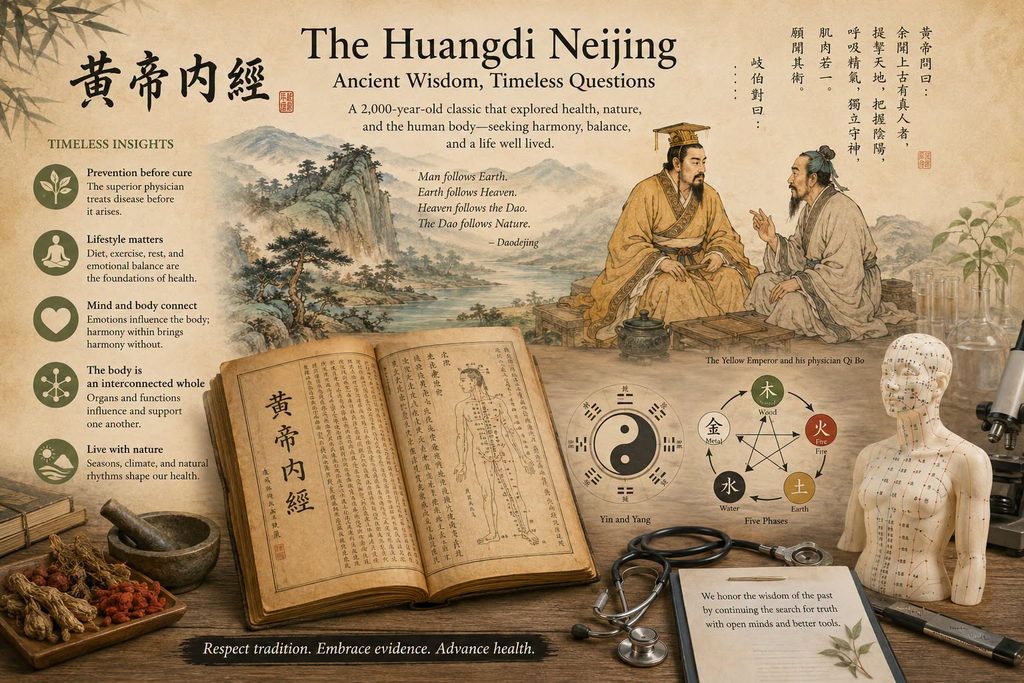
The history of Chinese medicine is inextricably woven with the threads of Daoist philosophy, to the extent that the two are often considered inseparable in their classical origins. Emerging from the same ancient wellspring of thought during the Warring States period and Han Dynasty, Chinese medicine adopted the Daoist understanding of a universe governed by constant change and cyclical balance. The core concepts of Yin and Yang, he interdependent opposites whose dynamic tension creates all phenomena, and the Five Phases (Wu Xing), which describe the cyclical patterns of transformation in nature, became the foundational diagnostic and physiological framework for understanding health and disease. The Daoist pursuit of longevity and harmony with the Tao (the Way) directly shaped medicine’s primary goal: not merely to cure illness, but to cultivate health, prevent disease, and extend life by maintaining the body’s vital energy (Qi) in a state of balanced and unimpeded flow. This is articulated in classics like the Huangdi Neijing (The Yellow Emperor’s Inner Canon), which is structured as a dialogue between the Yellow Emperor and his ministers, including his Daoist mentor, and emphasizes living in accordance with the natural rhythms of the seasons and the cosmos.
This philosophical foundation translated directly into every branch of medical practice. Daoist adepts, often secluded in mountain hermitages, became the era’s most dedicated physiologists and pharmacologists, experimenting with minerals, herbs, and meditative techniques in their quest for immortality. Their sophisticated understanding of Qi and its circulation through the body’s meridian system formed the basis of acupuncture and Qigong (energy cultivation exercises). The alchemical pursuits of Daoists, both external (waidan: using elixirs) and internal (neidan: using meditation and internal visualization), profoundly influenced Chinese herbal medicine and pharmacology, seeking to transform the body’s very substance. Even today, the practice of Chinese medicine is imbued with this Daoist heritage: a practitioner diagnoses by discerning patterns of imbalance in a patient’s Qi and prescribes treatment, whether herbal formulas, acupuncture, or dietary advice, with the aim of restoring the individual’s harmonious connection to the natural world and the eternal, ever-flowing Tao. The physician’s role is not to conquer disease but to act as a guide, helping the body’s innate wisdom, cultivated through Daoist principles, to re-establish its own internal order.