1. Preparation: Body, Mind, and Space
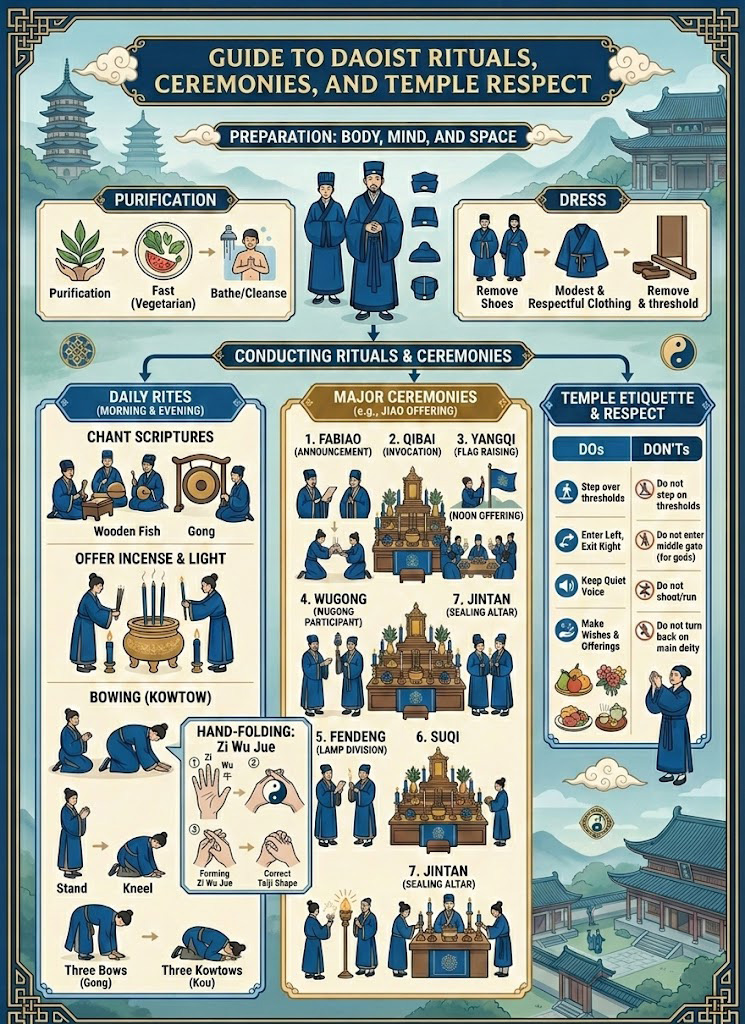
This guideline provides a deep dive into the protocols illustrated in the updated infographic, specifically focusing on the Zi Wu Jue hand gesture and the structured rituals of a Daoist temple visit.
1. Preparation: The Path to Purity
Before engaging with the sacred, a practitioner must align their internal state with the external environment.
- Purification (Jie): Practitioners often undergo a period of fasting (vegetarianism) and physical bathing to cleanse the “dust” of the mundane world.
- Dress and Decorum: The blue robe (Daopao) is the standard attire, symbolizing the vastness of the sky and the Dao. When visiting, shoes should be removed where indicated, and clothing must remain modest and respectful.
- The Threshold: Never step on the wooden threshold of a temple door. This is viewed as stepping on the “shoulders” of the temple’s guardian; always step over it.
2. Master the Hand-Folding: The Zi Wu Jue
The core of Daoist ritual is the Zi Wu Jue (子午诀), a gesture that represents the “Taiji” or the primordial union of Yin and Yang.
- The Left Hand (Yang): The left thumb reaches into the “tiger’s mouth” of the right hand to press the base of the ring finger—the Zi (子) position.
- The Right Hand (Yin): The right thumb presses the tip of the right middle finger—the Wu (午) position—while the right hand is clasped by the left.
- The Symbolic Result: This specific interlocking forms the shape of a Taiji Diagram. Internally, it is believed to bridge the “North and South” poles of the body’s energy system, aiding in concentration and the preservation of Qi.
3. The Ritual of Bowing and Kowtowing
The infographic distinguishes between daily standing rites and the more formal “Three Bows, Nine Kowtows” (San Li Jiu Kou).
Standing Bows (Gong)
- The practitioner stands with feet in an “Eight” (八) shape, heels slightly apart.
- The clasped hands (Zi Wu Jue) are raised to the level of the nose and then lowered to the abdomen as the body bows.
The Kowtow (Kou)
- Kneeling: Lower yourself onto the mat with a focused and sincere mind.
- Hand Cross: Place the hands flat on the cushion. The left hand is placed over the back of the right, forming the shape of the character for “Ten” (十).
- The Touch: The forehead must touch the back of the hands, specifically between the thumbs.
- Sequence: In major ceremonies, three kowtows are performed for each of the three bows, totaling nine, to show ultimate devotion to the Three Pure Ones.
——–
To perform the San Li Jiu Kou (Three Bows, Nine Kowtows) correctly, follow these step-by-step instructions based on the traditional protocols and the “Taiji” hand gesture.
Phase 1: Preparation and the Taiji Hand Gesture
Before beginning the movement, you must form the correct hand-folding position.
- Form the Taiji Diagram: Insert your left thumb into the “tiger’s mouth” of the right hand to press the Zi (子) position (base of the ring finger).
- Complete the Lock: Press your right thumb onto the Wu (午) position (tip of the middle finger).
- The Clasp: Wrap the remaining four fingers of your left hand around the outside of the right hand. This forms the “Embracing Unity” shape.
- Stance: Stand with your feet in an open “V” (eight) shape, with your heels slightly apart.
Phase 2: The Standing Bow (Baoquan Li)
Perform this once before each set of three kowtows.
- Starting Position: Hold the Taiji-clasp at chest level.
- Elevation: Raise the clasped hands smoothly until they are level with the tip of your nose.
- The Bow: Bow your upper body forward, lowering the hands back toward your abdomen as you bend.
Phase 3: The Three Kowtows (Koubai Li)
After the standing bow, transition to the floor for three prostrations.
- Kneel: Lower yourself onto your kneeling mat with a sincere and focused mind.
- Place the Right Hand: Place your right hand flat on the cushion first.
- Form the “Ten” (十) Shape: Place your left hand over the back of your right hand to form a cross shape.
- The Prostration: Lower your head until your forehead touches the back of your hands. Your head should be centered between your thumbs.
- Repeat: Rise slightly from the prostration while remaining on your knees and repeat the head-touching movement two more times for a total of three kowtows.
Phase 4: Completing the “San Li Jiu Kou”
To complete the full “Three Bows, Nine Kowtows” cycle:
- Round 1: One Standing Bow + Three Kowtows.
- Round 2: Stand back up, perform one Standing Bow + Three Kowtows.
- Round 3: Stand back up, perform one Standing Bow + Three Kowtows.
- Conclusion: Stand up and perform a final standing bow to conclude the ritual.
Important Note: Throughout the process, keep your movements quiet and graceful, avoiding any sudden or loud impacts on the floor.
4. Temple Etiquette & Taboos
To maintain the “Ling” (spiritual efficacy) of the temple, specific behaviors are expected of all visitors:
| Action | Proper Conduct (DO) | Taboo (DON’T) |
| Navigation | Enter through the Left gate and exit through the Right. | Never use the Middle Gate, which is reserved for the deities. |
| Movement | Move with quiet grace and maintain a low voice. | Do not run, shout, or behave in a rowdy manner. |
| Posture | When kneeling, keep your body aligned with the altar. | Never turn your back directly on the main deity or point your feet toward the altar. |
| Offerings | Use fresh fruit, flowers, or incense as a sign of sincerity. | Do not offer meat or “pungent” vegetables (onions, garlic) during a fast. |
5. Major Ceremonies (Jiao)
The central column of the infographic details the liturgical steps of a Jiao offering:
- Fabiao: The announcement to the heavens.
- Qibai: The formal invocation of the gods.
- Yangqi: The raising of the sacred flags.
- Fendeng: The “Division of Lamps,” spreading the light of the Dao.
- Jintan: The final “Sealing of the Altar” to conclude the sacred event.