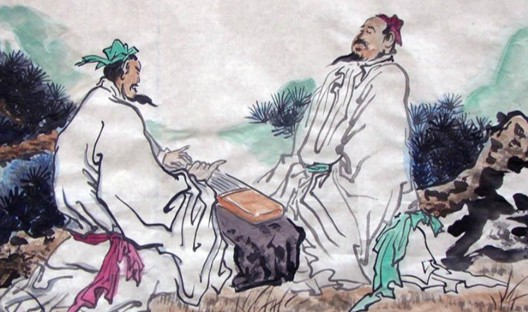
Guo Xiang (郭象, d. 312 CE) was one of the most influential philosophers of early medieval China and a central figure of the Wei–Jin “Neo-Daoist” (玄学, Xuanxue) movement. His fame rests primarily on his redaction and commentary on the Zhuangzi. The text we read today is largely the edition he produced. Earlier versions of the Zhuangzi were longer, disordered, and inconsistent; Guo Xiang reorganized, edited, and philosophically reinterpreted them into a coherent work. In doing so, he didn’t just preserve Daoism, he reconstructed it.
He lived during the Western Jin dynasty, a period marked by political instability but extraordinary intellectual creativity. Scholars of this era sought new philosophical syntheses after the collapse of the Han dynasty. Confucian orthodoxy had weakened, Buddhism was entering China, and Daoist thought was being reinterpreted in sophisticated philosophical ways. Guo Xiang stood at the center of this transformation.
Guo Xiang stands as one of the most transformative interpreters in the history of Chinese philosophy. Living during the turbulent Wei–Jin period, he inherited a Daoist tradition rich in poetry, paradox, and ambiguity, yet lacking systematic philosophical clarity. Through his redaction and commentary on the Zhuangzi, he reshaped Daoism into a coherent worldview centered on spontaneity, natural processes, and the self-organizing character of reality. His work effectively determined how generations would understand Daoism.
At the heart of Guo Xiang’s philosophy is the rejection of any external creator or metaphysical foundation. He argued that the universe does not arise from a single source or guiding intelligence but unfolds through the spontaneous transformation of all things. Each entity participates in its own becoming, and the order of the world emerges from the mutual interaction of countless processes. This radical naturalism removed the need for supernatural explanations while preserving a deep sense of harmony in the world.
Guo Xiang’s reinterpretation of ziran (naturalness) further strengthened his philosophical vision. For him, naturalness did not imply randomness or passivity, but rather the idea that every being flourishes by expressing its own inherent nature. Harmony arises when each thing follows its own path within a web of relationships. This view anticipates modern ideas of emergence, where complex systems organize themselves without central control.
Unlike later religious Daoism, which became associated with alchemy, immortality, and mystical practices, Guo Xiang’s Daoism remained grounded in the observable world. He also rejected the stereotype of Daoist withdrawal from society, arguing instead that social roles and political life could be understood as natural expressions of circumstance. In this way, he helped reconcile Daoist thought with Confucian ethics and everyday life.
Guo Xiang, who envisioned a self-organizing, interconnected universe, resonates with contemporary systems theory, ecology, and scientific naturalism. By demystifying Daoism without diminishing its depth, he revealed a tradition capable of speaking to both ancient and modern understandings of reality.